

Cuban Man '24' Proud Of His 4 Extra Fingers, Toes
They call him "Twenty-Four." Yoandri Hernandez Garrido's nickname comes from the six perfectly formed fingers on each of his hands and the six impeccable toes on each foot.
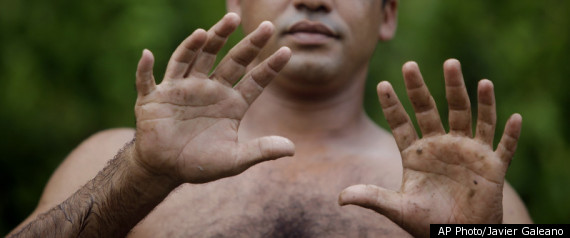 Hernandez is proud of his extra digits and calls them a blessing, saying they set him apart and enable him to make a living by scrambling up palm trees to cut coconuts and posing for photographs in this eastern Cuban city popular with tourists. One traveler paid $10 for a picture with him, Hernandez said, a bonanza in a country with an average salary of just $20 a month.
"It's thanks to my 24 digits that I'm able to make a living, because I have no fixed job," Hernandez said.
Known as polydactyly, Hernandez's condition is relatively common, but it's rare for the extra digits to be so perfect. Anyone who glanced quickly at his hands would be hard-pressed to notice anything different unless they paused and started counting.
Hernandez said that as a boy he was visited by a prominent Cuban orthopedist who is also one of Fidel Castro's doctors, and he declared that in all his years of travel he had never seen such a case of well-formed polydactyly.
"He was very impressed when he saw my fingers," said Hernandez, who is the only one in his family to be born with extra digits.
In a part of the world where people's physical traits are often the basis for nicknames – even unflattering ones like "fatty" or "shorty" – "veinticuatro" ("twenty-four" in English) is not an insult but rather a term of endearment, and Hernandez, now 37, said his uniqueness has made him a popular guy. He has a 10-year-old son with a woman who now lives in Havana, and his current girlfriend is expecting his second child.
"Since I was young, I understood that it was a privilege to have 24 digits. Nobody has ever discriminated against me for that," he said. "On the contrary, people admire me and I am very proud. I have a million friends, I live well."
Nevertheless, it occasionally caused confusion growing up.
"One day when I was in primary school, a teacher asked me how much was five plus five?" Hernandez recalled. "I was very young, kind of shy, and I didn't say anything. She told me to count how many fingers I had, so I answered, "12!"
"The teacher was a little upset, but it was the truth," he said.
Hernandez said he hopes he can be an example to children with polydactyly that there's nothing wrong with them.
"I think it's what God commanded," he said. "They shouldn't feel bad about anything, because I think it's one of the greatest blessings and they'll be happy in life."
Is the government doing enough to protect us online?
Thursday, July 26, 2012
More than 400 million people trust Google with their e-mail, and 50 million store files in the cloud using the Dropbox service. People manage their bank accounts, pay bills, trade stocks and generally transfer or store huge volumes of personal data online. Who is ultimately in charge of making sure all this information is secure: the government, the companies or the users?
At a lively panel discussion at the annual Black Hat security conference in Las Vegas on Wednesday, computer security experts discussed the roll of the government in online security. The debate centered on whether the U.S. government should take the lead in setting security standards for the industry or whether companies are responsible for their own security and that of their users.
"I lose my cool when I hear people from the government say people from the private sector need to stand up. Providing for the common defense is what the government is supposed to do," said security systems expert Marcus Ranum.
The U.S. government is considering various security bills that address online security standards.
One controversial bill, the Cyber Intelligence Sharing and Protection Act, would allow private companies to share data with government agencies when there is an attack or breach, without fear of lawsuits from customers over the shared data. However, several civil liberties groups believe the bill needs more restrictions on how the government can use that shared information.
Creating laws isn't the only way the government can push for greater security. It can also use its significant financial sway on major companies.
"The government is an enormous purchasing agent in our industry. Why can't the NSA come up with a security standard that they like?" asked Bruce Schneier, security critic and author. "Let them go to the operating system companies, the database companies, the cloud providers, and say if you want the government business, you have to adhere to this."
Opponents of the government-control approach say corporations are responsible for their own security online, just as they would be for the physical security of their offices or property. Law enforcement is there to respond to incidents, not make sure the doors are properly locked, they contend.
Some of the enthusiasm for the government to take the initiative on cyberthreats is rooted in distrust of big Internet companies.
At one point, Jennifer Granick, the director of civil liberties at the Stanford Law School Center for Internet and Society, asked the large audience of security professionals who they trusted less, Google or the government? The majority raised their hands for Google.
"I fear Google more than I pretty much fear the government," said panelist Jeff Moss, the founder of Black Hat and DEF CON. "Google, I'm contractually agreeing to give them all my data."
For now, mutual distrust between the government and the private sector is keeping the two sides from working together as effectively as possible, and the public could suffer because of it.
"The biggest risks right now are not the bad guys," said Schneier. "They are the good guys who are not doing enough."
The users do have some responsibility to protect their data online, but the panelists agreed that regular people will usually bypass any extra steps, even if they are in their best interest, in the name of convenience.
Aurora heroes: Three who gave their lives

Great evil often brings out the best in good men, men like Todd Beamer on Flight 93, Medal of Honor recipient Michael Murphy in Afghanistan and now the Aurora three -- the three young men, each in different parts of theater nine, who gave their lives to protect their girlfriends.
Twenty-five-year-old Jon Blunk was sitting next to his girlfriend, Jansen Young, at the midnight premiere of "The Dark Night Rises" when the gunman (who shall remain nameless) opened fire in the dark theater. Blunk instinctively pushed his girlfriend to the ground and threw his body on top of hers. Blunk, a security guard, served eight years in the Navy and was in the process of re-enlisting in hopes of becoming a Navy SEAL, family and friends said. He was killed in the gunfire; his girlfriend survived.
Twenty-four-year-old Alex Teves dived on top of his girlfriend, Amanda Lindgren, when the gunfire erupted. Covering her body, he took the bullets so they did not harm her. She survived the massacre; he did not.
Matt McQuinn, 27 years old, threw his body in front of his girlfriend, Samantha Yowler, as the shooting continued. Yowler survived with a gunshot wound to the knee; McQuinn's body absorbed the fatal shots.
These men were three of the 12 innocent people killed early that morning. Their incredible sacrifice leaves us asking: Why? Why would a young man with his entire life ahead of him risk everything for a woman he has no legal, financial or marital obligations to?
As Hanna Rosin so eloquently pointed out in a recent article, calling it chivalry would be a tremendous understatement. By all appearances, these men believed that a man has a responsibility to protect a woman, even to the point of death. They believed that there are things in life worth dying for and the innocent woman sitting next to them was one.
 Meet the man behind the Aurora crosses
  Widow's kids struggle to understand
  Babysitter tried to save youngest victim
 They believed, to put it simply, in a code of honor. They put the lives of the women before their own, an old fashioned notion to be sure, but certainly an honorable one (if you have any doubt, ask the survivors). Their instincts were to protect, not run away.
From all accounts, these young men were average, working men in their 20s. (We know a little about Jon Blunk, but not much, and we know even less about the others.) Like all men, they had their own struggles. After his death we learned that Blunk had an ex-wife and two children living in Nevada. He was scheduled to visit them to resolve marital issues. This isn't to take anything away from Blunk or the other two heroes, but to illustrate that, in spite of shortcomings, men can still recognize what it means to be a good man and act like one.
This is especially important given the state of many men today. Record numbers of men aren't working or even looking for work. Record numbers aren't marrying or even acting as fathers to their children. These men need heroes to imitate whom they can relate to in everyday life, not just make-believe superheroes who catch their imagination for an hour or two. They need heroes like the Aurora three.
While much of the media obsesses over the psychology and motivations of this deranged killer, we should hold the Aurora three high. It is only by telling their story that this code of honor will survive for future generations of men. "The world is forwarded by having its attention fixed on the best things," Matthew Arnold wrote.
In an age when traditional manhood has been increasingly relegated to fiction -- capes, masks and green screens -- these three men stand as real-life heroes. Their actions remind us that good triumphs over evil, not just in movies, but also in reality.
Why men fall asleep after having sex
Monday, July 23, 2012 Here’s some news from the world of science that could settle some old disputes in the battleground of the marital boudoir. Throughout history, unsatisfied wives and girlfriends have wondered why their otherwise-perfect male partners roll over and fall straight to sleep after sex instead of engaging in endless chit-chat. A team of researchers from Inserm in France believe they have the answer: it seems that men just can’t help it. Brain scans showed that after orgasm, the thinking area of men’s brains actually shuts down. Other parts then send a message out that the job is done, to let the body know that its interest in sex is no longer required. Then, (just in case even further explanation is needed), the brain is hit with surges of oxytocin and serotonin, nature’s own “shut up and go to sleep” chemicals, rendering dudes all but powerless against the urge to crash
Subscribe to:
Comments (Atom)


